
Separate Northampton County Tax Fields
Northampton County's assessment system holds plenty of detail. Land, building, total market, and assessed values sit beside owner lines. Acreage, parcel keys, and sale fields appear there too. The Commissioner also records transfers from deeds and wills. The office corrects tax maps, and it administers exemptions, new construction, and land-use or use-value records. Bill, payment, or delinquency questions go to the Treasurer's account. Same parcel, different tax question.
| Field | What It Shows | Where |
|---|---|---|
| Land / building / total assessed | Assessment values used in the tax administration record | Commissioner of the Revenue CAMA |
| Land / building / total market | Market-value fields displayed alongside assessed values | Commissioner of the Revenue CAMA |
| Owner and parcel keys | Tax owner lines, tax map, CAMA_ID, and parcel ID | CAMA and GIS parcel layer |
| Exemption / use-value data | Flags and records administered by the Commissioner | Ask the Commissioner about the parcel entry |
| Bill / payment status | Current account, collection, or delinquency question | Northampton County Treasurer |
An assessed value exists for taxation. It is not the last sale price. It is not a market appraisal, nor is it the amount still due on the account. The GIS parcel layer adds sale price, sale date, sale type, and a sale-validity code, context that still needs the deed and assessment card beside it.
Northampton's CAMA entry screen is the county's assessment portal. Open the CAMA property search to see its current search modes.
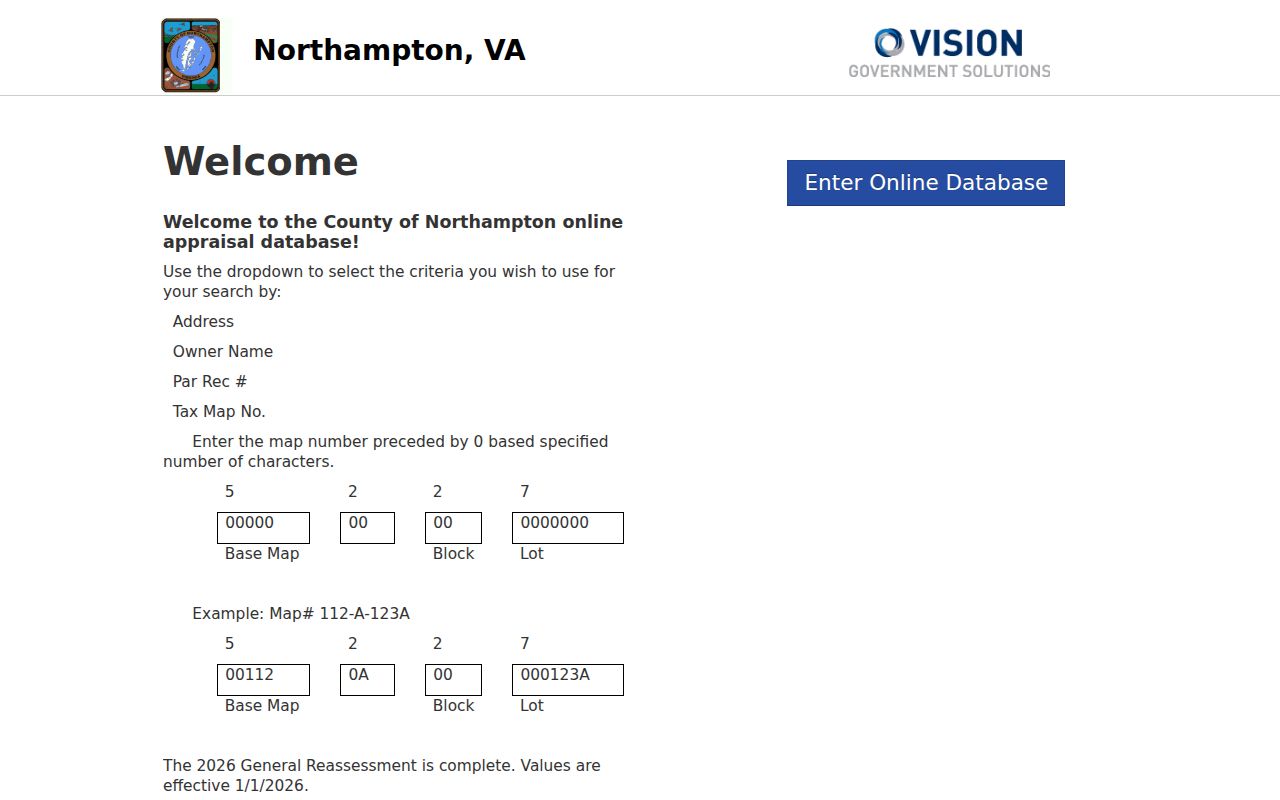
Match the parcel; confirm the balance with the Treasurer.
Northampton County 2026 Property Tax Reassessment
Northampton County's 2026 general reassessment is complete. It took effect January 1, 2026. Notices went out in March. Administrative appeals were due by April 30, 2026. November 1, 2026 is the Board of Equalization date. A 2025 ordinance put the county on a biennial reassessment schedule, with this cycle effective in 2026.
These dates belong to the 2026 notice alone, so treat them as one cycle's calendar rather than a standing one. An owner who questions an entry should pull the parcel card and the county's latest notice, then ask the Commissioner which appeal route and evidence apply. The county publishes no public assessment-appeal form URL, and the Treasurer posts no parcel bill-search address.
The CAMA reassessment notice carries the county's current cycle information. Keep your copy with the parcel identifier. That keeps later comparisons on the same assessment year.
Northampton County Tax Bill Lookup
The Treasurer bills and collects Northampton County's real-estate taxes. The county publishes no searchable property-by-property bill URL. The Treasurer's public page explains duties and payment routes. For a particular tract, give staff the owner name, situs address, and tax map or parcel identifier. Then ask about the bill year, amount due, payment status, and any delinquency notice.
- Find the parcel in CAMA and copy the tax map number, owner lines, and situs location.
- Contact the Treasurer at 757-678-0450 or use the payment route linked from its official page.
- Ask which bill year and account status are current, including posted payments or credits.
- For a delinquency or sale concern, request the relevant existing account or court record; no public delinquent list was located.
- Assessed value
- The Commissioner’s property value record used in local tax administration.
- Tax rate
- The county rate applied per $100 of assessed value.
- Tax account
- The Treasurer’s bill, payment, and collection record.
- Tax lien
- A recorded or statutory claim tied to unpaid tax; confirm its status with the custodian.
Northampton County’s Real-Estate Tax Rate
Northampton County lists a 2026 real-estate tax rate of $0.6995 per $100 of assessed value. The 2025 rate was $0.705 per $100. Two records drive any bill here. The county sets the rate, and the assessor sets the parcel's assessed value. Neither one alone tells you the tax owed.
A quick estimate divides the assessed value by 100 and multiplies by the rate. Credits, fees, and other line items can shift the total, so the Treasurer's account is the final word on the balance due. Comparing two years gets tricky. The assessment may have moved, the rate may have moved, or account entries may have changed. Keep the value year and the rate year separate, since pairing a 2026 value with a 2025 rate mixes two different bills. Never use the last sale price as the tax base, and treat any market-value field as context rather than a bill amount.
For scale, $100,000 of assessed value at the 2026 county rate works out to $699.50 before adjustments. At $250,000, the same arithmetic gives $1,748.75. The county's public table is where the adopted rate should be verified before comparing years. If a notice or payment history is disputed, contact the Treasurer with the owner name and the exact tax-map or parcel identifier, and ask the Commissioner separately about the assessment record or any exemption flag. The official tax-rate schedule shows the real-estate rate comparison for 2025 and 2026.
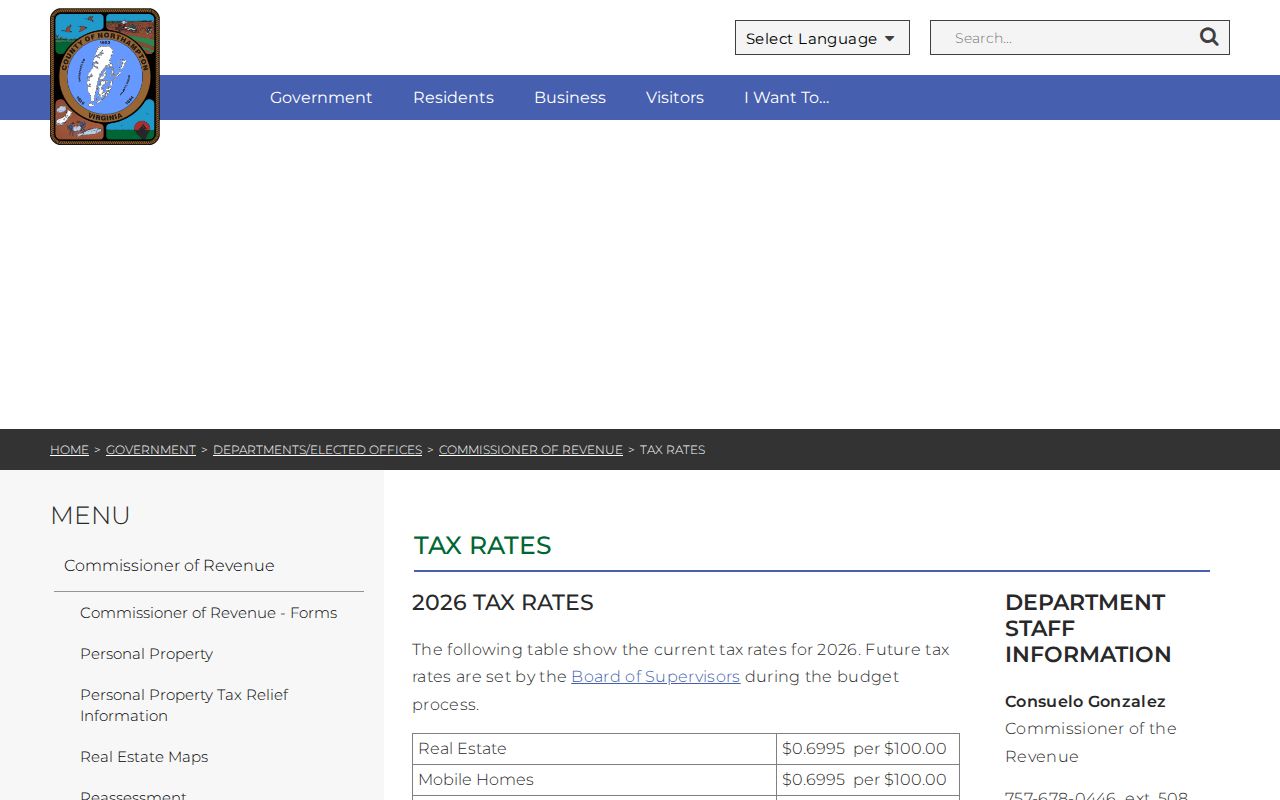
Use the adopted rate for the bill year. The Treasurer can reconcile the exact amount for an individual parcel.
Northampton County Delinquent Tax Records
The Northampton County Treasurer bills and collects property taxes. The office publishes no delinquent-tax list, no searchable tax bill portal, and no tax-sale notice database online. So a direct question works best. Ask the Treasurer whether a parcel's account is current. Also ask whether any public delinquent list or sale file exists. When a tax sale is in play, pull the Circuit Court record. Then pull the later recorded deed. A low sale price or a third-party notice is never enough to confirm what happened.
Scam notices thrive on urgency, so treat any delinquent-tax letter with care. Verify it through the county's posted contacts before paying anything. The Treasurer's number is 757-678-0450. Never call a number that appears only on the letter itself. When you reach the office, ask for the parcel number and tax year in writing. That way the account matches correctly.
The Treasurer's page names the county office and its payment route. It serves as a contact reference rather than an account lookup.
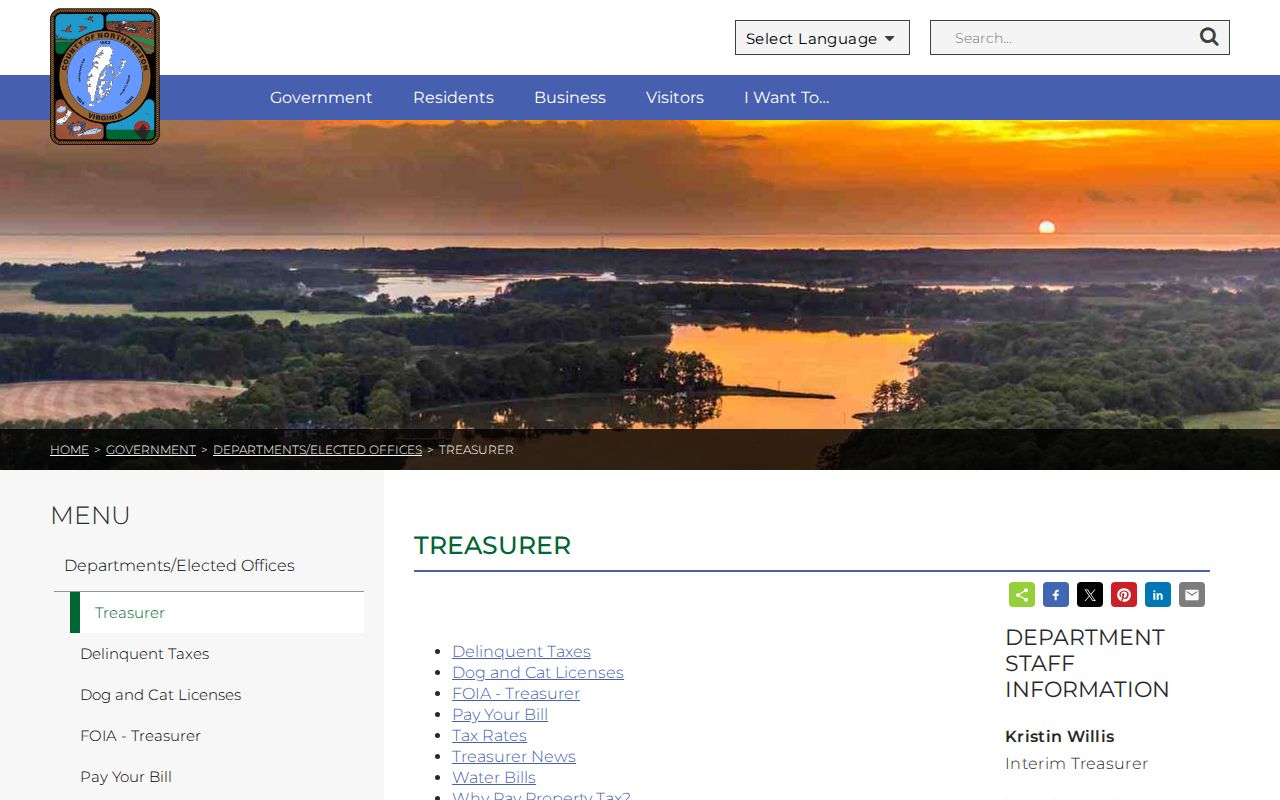
The public page shows no live account balance, so call the office for a parcel-specific answer.
Match the Northampton County Tax Year
Northampton County updates CAMA monthly and its GIS map quarterly. Those schedules set fair expectations. They cannot promise that a freshly recorded deed or correction has reached every screen. So check each record at its source. For a transfer, look at the Clerk's latest deed record. For an assessment, note the CAMA value year and save the notice. For payment, ask the Treasurer about the current account. One date never makes all three current.
The CAMA parcel service carries market and assessed values for land, building, and total, along with sale date and sale validity fields. A non-market transfer or an estate distribution can skew a casual value comparison. Read the sale type and validity code as context. They are not a legal conclusion on their own.
Northampton County Exemption and Use-Value Records
The Commissioner of the Revenue keeps Northampton County's exemption and land-use records. This work sits inside the assessment workflow. No complete public list of exemption categories or application form appears online. Check the parcel card first for any flag. Then ask the Commissioner which program and paperwork fit that land. An exemption on one parcel does not carry to another owner or year.
Split your questions when reviewing an assessment. The parcel's value is one issue. An exemption entry is another. Save the CAMA card and the notice. Write down the tax-map number. Then ask for the current filing route. The Commissioner handles the assessment data. The Treasurer explains the bill once value and rate are applied.
A use-value or exemption indicator is a clue. It is not proof that a benefit is active for the bill year in question. Confirm the parcel, owner of record, effective year, and supporting filing with the Commissioner. No online application or full category list exists. Call 757-678-0446 before trusting an old notice or a prior owner's status.
Appeal a Northampton County Tax Assessment
The county's public notice sets two deadlines for the 2026 general reassessment. Administrative appeals are due by April 30. Board of Equalization appeals are due November 1. The new assessment takes effect January 1, 2026. If you appeal, identify the parcel, keep the notice, and ask the Commissioner of the Revenue for the current filing steps and acceptable evidence. No appeal form appears on the public site. Do not rely on an unverified form, and do not assume the 2026 dates apply to a later reassessment cycle.
2026 appeal timing. The county notice lists April 30, 2026 for requested administrative appeals and November 1, 2026 for Board of Equalization appeals. Confirm the live procedure and deadline with the Commissioner before filing.